Health Asset Management
The Grow Wellthy Blog
Practical ideas for financial advisors who want to manage their health with the same intention as their wealth.
- Mind
- Mend
- Meals
- Move

|
Let me ask you something. Think about the advisors who came before you. The colleagues you've watched build their practices over the years. Maybe even yourself. Have you noticed a pattern? Most people come into this career with an emptier bank account and a fuller health account. They're young. They have energy. Their bodies mostly take care of themselves. Then, year by year, the two accounts quietly trade places. The bank account fills up. The health account drains. More money. Less health. Richer, but sicker. I heard some version of this story over and over when I interviewed 508 financial advisors for my book. It came up so often that I gave it a name. I call it The Big Swap.  What The Big Swap actually costs The Big Swap is trading your health for wealth in your prime earning years, then spending that wealth trying to buy your health back in retirement. The problem is that the math doesn't work. Rebuilding health later is a lot harder than protecting it now. Muscle, metabolism, sleep, and recovery all get more expensive to rebuild with every decade. And years of stress, short sleep, and sitting don't show up all at once. They compound quietly, until one day they don't. Think about it this way. You'd never tell a client to live off their retirement account in their 40s and hope it refills itself by 65. Yet that's how many of us treat our health. The stakes are real. A Mayo Clinic study of 183 countries found that Americans live an average of 12.4 years with disease or disability, the widest gap between lifespan and healthspan in the world. I call those years the sickspan. They're the years spent managing disease instead of enjoying the life you planned for.  I grew up watching this happen My dad was a financial advisor for 32 years, so I grew up in this industry. I celebrated clients' weddings and retirements right alongside him. I also went to their funerals. Some clients retired early because of illness. Others got "one good year" before their health took over. And some, like Jeff and Julie, who had planned the dream cruise they never got to take, didn't make it out of the starting gate. 
My dad and me: 1984, 1992 and 2024. We spend a lot of time talking about retirement risks. Sequence of returns. Market downturns. Inflation. But the biggest risk to a retirement plan usually isn't in the market. It's in the client's body. And in yours. It's a business risk, too Your health isn't only personal. It's one of your firm's most important assets. What happens if you're sidelined for six months? Who carries the weight? Your partner? Your staff? Your family? What happens to client trust, to revenue, to the succession plan you've been building? Most advisors have thought about that scenario on paper. Far fewer have a plan for preventing it. I made The Big Swap, too I'm an exercise physiologist. I've spent my career teaching people how to be healthy. And at 42, I nearly lost my life to sepsis while living in Australia with my husband and our two young kids. I survived, but I left that hospital with a body that felt a decade older. (You can read the full story here.) What surprised me most was that I thought I was doing everything right. I worked out. I watched what I ate. And I powered through stress and short sleep, because that's what high achievers do. Looking back, I was trading health for achievement. I had been day-trading my health when what I needed was a long-term portfolio strategy. If it can happen to an exercise physiologist, it can happen to anyone. Build your health the way you build wealth The strategy that brought me back is the same one you already use with clients. Small actions, in the right order, done consistently, given time to compound. Order matters more than most people realize. You wouldn't tell a client to invest aggressively while they're carrying high-interest credit card debt. You'd pay that down first. Health works the same way. Most health plans fail because they start with diet and exercise. But if your sleep and stress are running a deficit, a new workout program usually ends in burnout or injury. I organize this into four levels I call the Hierarchy of Wellth™, and you build them from the ground up: 
You don't have to do everything at once. Find your weakest level and start there. Try this right now Want a quick read on one of your Move numbers? Stand up near a wall or counter. Lift one foot and time how long you can balance without touching anything. Then switch legs. If you made it to 60 seconds, your balance is in decent shape. Over time, aim for two steady minutes on each leg. If you started wobbling at 10 or 20 seconds, that's useful information. Think of it as an early correction signal. Balance reflects your core, hips, ankles, and your brain's sense of where your body is in space. Now try one more. Sit cross-legged on the floor and stand up without using your hands or knees. Every hand, knee, or elbow you need for support is a data point, and research has linked this simple test to longevity. (If you have joint or balance concerns, skip this one or keep support close by.) Don't worry about doing it perfectly. Lots of people can't. What matters is that you practice. It's why I post a get-up video on LinkedIn every Saturday. So what do we do with that? Write your results down and test again in a month. Numbers tell a story, and watching yours change is surprisingly motivating. Want a fuller picture than one balance test? Take the Health Credit Score quiz. It's a quick first look at where you stand across more than one area of your health, a lot like checking your credit score before a big financial decision. Make your own Health Balance Sheet My client Mike started with something simple. He drew a line down the middle of a page, put Assets on one side and Liabilities on the other, and listed everything he could think of.  Good sleep. Gym twice a week. No medications. Then the other column: stressed, skipping lunch, an extra 20 pounds, low energy, snacking at night, too much alcohol, low back pain, blood pressure creeping up. Seeing it on paper changes the conversation. "I should get healthier" becomes a clear picture of where you stand and what deserves attention first. Harris, an advisor who runs a $2.4B practice in New Jersey, did the same thing. He wanted to lose 90 pounds, get off his blood pressure medication, and be a participant rather than a spectator in his new granddaughter's life. He did all three. 
Harris before, on the cover of Forbes, and after, on the floor with his granddaughter. Your balance sheet will look different from Mike's or Harris's. Your goals are your own. That's the point. Two tracks, not a trade  The advisors who stay healthy the longest don't treat health and wealth as a trade-off. They treat them like the two rails of a railroad track. You need both to go the distance. Markets recover. Portfolios rebound. Health is much harder to buy back once it's gone. You already know how to build wealth. The question is whether you'll have the health to enjoy it.  So let me ask you: if you drew your own Big Swap chart today, where would your lines cross? Want help applying this? You're responsible for your health. You don't have to figure it out alone. At Grow Wellthy, we help financial advisors understand where they stand, decide what deserves attention first, and keep it working over time. Think of it like financial planning for your health. If this sounds familiar, I'd love to talk. Book a 15-minute Fit Call. We'll talk about your goals and find the right starting point. Book your Fit Call See how we work with advisorsWant to start on your own first? The full Hierarchy of Wellth framework and the Health Balance Sheet are in my book, Grow Wellthy: The Financial Advisor's 4-Step Plan to Protect Your Health Like an Asset. Get the book here. Stevyn The fever came out of nowhere. Within three days, I was fighting for my life. We were living in Australia for a year while I launched a new kettlebell exercise program. I had been in bed for days with a fever that refused to break. I'm sure it's just a virus, I thought. It'll pass. It didn't. On Monday morning, I dragged myself to the doctor, who ran some blood work and sent me home to rest. A few hours later, my phone buzzed. "You need to get to the ER right now." My husband grabbed our kids, ages 5 and 9 at the time, and helped me into the car. At the hospital, the doctor delivered the news: "You're septic. The infection is severe. You need emergency surgery." I needed an emergency hysterectomy. I remember very little after that, except hearing the nurse say my arteries were beginning to collapse. I said a quick prayer and smiled at my young family as I was wheeled down the hall, unsure if I would see them again. I survived. But those five days in the hospital aged my body a decade. 
The morning after my emergency surgery in Australia, with my kids. A health expert who missed the warning signs The aggressive antibiotics ruined my gut health. The hysterectomy threw my hormones into chaos. I lost all the muscle I had spent years building, and I developed a frozen shoulder that lasted 18 months. When I left Australia, I was a shell of my former self. Over the next two years, I gained weight, became pre-diabetic, and was diagnosed with adrenal fatigue. Each time I tried to exercise like before, I got injured. When I cut calories, I gained weight. Nothing worked. I had a master's degree in exercise physiology and twenty years in the fitness industry. How could I not figure this out for myself? Looking back, it wasn't really out of nowhere. My undiagnosed PCOS had quietly set the stage, and years of overtraining, undersleeping, and running on stress hormones did the rest. I had built my identity on understanding the human body, yet I had completely missed how my daily habits were wearing down my own. The missing piece The answer came from the last place I expected: a consulting project for a massage chair company. Late one night, reading research papers in my closet so I wouldn't wake my family, I realized stress management and sleep weren't "nice to haves." They were the foundation. The irony wasn't lost on me. I was a self-proclaimed night owl who "worked well under pressure." So instead of pushing harder, I started taking evening walks with my family after dinner. I set a 9 PM wind-down alarm. I started listening to my body's signals instead of overriding them. Even though I exercised less and ate more, I started to lose weight. Within three months, I dropped 20 pounds and reversed my pre-diabetes markers. Back to my dad's office I grew up as a financial advisor's daughter. In my dad's office, we celebrated clients' weddings, promotions, and retirements. We also mourned their funerals. Some were forced to retire early due to illness. Others only got "one good year." Many had the money, but not the health to enjoy it.
My dad and me: 1984, 1992 and 2024. Years earlier, I had sat next to one of the top financial advisors in the industry on a bus ride in Scotland. Despite his success, he confided that he'd just received bad news from his doctor. He was wealthy but felt poor at the same time. That image stayed with me. As my health came back, I saw the connection. What healed me followed the same principles advisors use every day: know where you stand, make small deposits consistently, and think in decades rather than days. So I went looking for answers. Over 18 months, I interviewed 508 financial advisors about their stress, nutrition, and health. Their average stress level was 7 out of 10. Here were experts at protecting their clients' futures, quietly spending down their own most valuable asset. That's why I founded Grow Wellthy. My near-death experience turned out to be a gift. It put me in exactly the right place to help the people I grew up around. This story is the opening chapter of my book, Grow Wellthy: The Financial Advisor's 4-Step Plan to Protect Your Health Like an Asset. Get the book here. If this sounds familiar, I'd love to talk. Book a 15-minute Fit Call, or see how we work with advisors. Book your Fit Call See how we work with advisorsStevyn I recently came across a fact that stopped me in my tracks:
Alcohol is a Group 1 carcinogen. That’s the same risk classification as asbestos and tobacco. Let that sink in for a second. I’ve spent years in the health space. I know alcohol carries risks. But I didn’t realize it had been placed in the highest category by the World Health Organization’s International Agency for Research on Cancer. That's the category reserved for substances with conclusive evidence that they cause cancer in humans. It’s not just heavy drinking, either. Even light to moderate drinking has been linked to an increased risk of several types of cancer, especially breast, liver, and colorectal. This realization isn't to spread fear or guilt, but to offer awareness. Most of my clients drink. Not excessively, but regularly.
They’re smart, successful, health-conscious people. And when we talk about alcohol, they often ask the same question: “What’s the safe amount to drink?” That’s where the conversation gets nuanced. From a cancer risk perspective, there is no truly safe level of alcohol. That’s not my opinion. It’s what organizations like the World Health Organization, CDC, and American Cancer Society all affirm. Even one drink per day can nudge your risk up, particularly for hormone-sensitive cancers like breast cancer. So… should you stop drinking? Maybe. Maybe not. Life isn’t lived in a lab. We live in communities, attend events, build relationships. And sometimes, those moments include alcohol. If you choose to drink, my goal is to help you drink with intention instead of on autopilot. Here’s what that might look like:
You don’t have to be perfect. But you do have to be honest with yourself and with your body. If your relationship with alcohol is working for you, great. If not, maybe this is your nudge to rethink things. Health is built on small, repeatable choices. And as I always say, the first step is awareness. This one piece of information, that alcohol is a Group 1 carcinogen, changed how I see alcohol. And I felt compelled to share it with you. Not to scare you, but to support you in making choices that align with how you want to feel today and years from now. If you’re curious about how to navigate alcohol in a way that supports your long-term health, I’m here for that conversation. Book a Discovery Call here: www.growwellthy.com/calendar There is an early pattern that often develops prior to a chronic disease diagnosis.
The more of these that stack up, the higher the risk. An advisor I spoke to yesterday had 4 of them but still thought of himself as someone who was healthy (just needing to lose a couple pounds). The reality of his situation is much more serious than losing a couple pounds. Any one of the issues below is a problem, but 3 or more is officially considered metabolic syndrome: 1) high triglycerides 2) blood sugar issues 3) a waist size > half your height 4) high blood pressure 5) low HDL Metabolic syndrome is the pathway to heart disease, diabetes, and cancer. This was an eye-opening moment for the advisor yesterday. Fortunately, there is something he can do about it. Step one is awareness of the reality of your situation. Step two is to take action to knock some of these off your plate. There are 5 pathways to health and 2 frameworks I teach to incorporate them into your life. These 5 pathways are: - blood sugar stabilization - metabolic flexibility - oxygen utilization - muscle & joint function - minimizing health traps & taxes When these get fixed, cravings go away, weight self-corrects, and peace and confidence show up in your health. What is your strategy for each? If you don’t know, consider joining my 6-week WellthPLAN workshop. It’s for financial professionals who have a successful practice and can shift a little of their focus to their health for 6 weeks to create their strategic wellness plan. People frequently wonder why I only work with financial planning professionals... Makes sense, everyone needs their health, right?
Let me ask you this question: Everyone (hopefully) has money. Why is a financial planner important? Yes, people have money, but not everyone has a clear, knowledgeable plan for their future. It's knowing how to cultivate your wealth that determines your financial future. How to protect it. How to grow it. How to prioritize its usage. And right there is the answer to the first question. I only work with financial planners because you get it. You get the philosophy. Everyone has a body, but not many people really know how to invest in their health the way they invest in their wealth. That's why we call it the WellthPLAN Workshop. In 6 weeks, we create a personalized plan for you to invest in your health as an asset. You might recognize some of the planning elements we focus on: What are YOUR goals? Is your priority to get back to triathletes? Or just to be able to play with your grandchildren? Your plan needs to reflect your goals. What are your current ASSETS AND LIABILITIES? We don't all start from the same place. We need to know where to start. What do we need to fix first? Where can we focus on good growth? How does this fit with your lifestyle? We don't want to draw up a plan that is unrealistic for your lifestyle. Whether its a hectic work calendar or heavy travel, we create a plan that fits with your lifestyle and makes healthy living realistic. At the end of 6 weeks, you walk away with a plan that is:
If you're interested in taking the next step, we start the next workshop in two weeks. Now's the time to hop on board and put your future first. Let me know if you'd like to chat about if this is the right fit for you. If you'd like to learn more about the program, you can see more here. 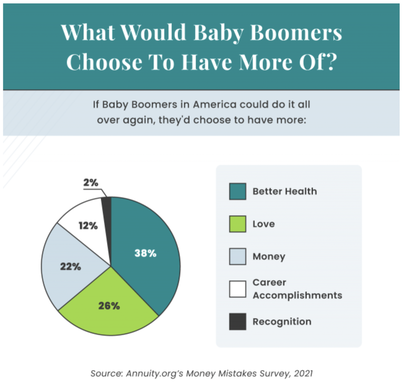 If Baby Boomers could go back and make different choices, many would prioritize better health over more money in their retirement planning. Several studies suggest that it takes more than money to plan for a successful retirement. Good health is a large part of the equation, but often overlooked.
One of the studies was a survey conducted by the Nationwide Retirement Institute. It found that 76% of Baby Boomers would prioritize their health over a larger retirement fund. This is a significant shift from previous generations who saw money as the most important factor in retirement planning. |

Hi, I'm Stevyn. Health Advisor for Financial Advisors I'm an exercise physiologist, author of Grow Wellthy, and the daughter of a financial advisor. This blog is about managing your health with the same intention as your wealth. Want help applying this? Book a 15-minute Fit Call. We'll talk about your goals and find the right starting point. Book your Fit Call |

|
|



10/26/2026
0 Comments